
Research at the Faculty of Education
Research with purpose, put to work.
Education is central to the biggest challenges facing society. None of the defining issues of our time – such as climate change, global inequality, or how to rebuild after COVID-19 – can be addressed without recognising that education is part of the solution. If we want to shape the future positively, education is one of the most important things that we can do.
As one of the world’s leading departments for education, the Faculty undertakes research that addresses these issues on an international scale. Its influence and impact touch communities worldwide, in particular those which are least-advantaged: from opportunity areas here in the United Kingdom, to some of the world’s poorest families in the Global South.
We have the experience and the capacity to set agendas and to lead the implementation of new thinking in policy and practice – and particular strengths in education and international development, psychology of education, and policy-focused research. But most of our research is defined by collaboration – with individuals, institutions, governments, public bodies, and organisations. These partnerships cut across sectors, disciplines and boundaries. Through them, the Faculty aims to deliver research that achieves deep and lasting results: unlocking potential, creating opportunities, and enabling happier, healthier lives.
How our research is structured
Research in the Faculty of Education is organised around eight Research Groups. These provide academics to collaborate with colleagues with similar interests and to develop joint projects. Many of our staff work across disciplines and belong to more than one Group.
Within our Research Groups, the Faculty houses three flagship Research Centres, which have a higher public profile, and are set up to support and run large-scale projects, disseminate research findings widely, and maximise impact.

Faculty research is governed by a Research Committee, chaired by the Director of Research. This committee provides strategic leadership and co-ordination for research across the Faculty, and enables further opportunities for cross-cutting projects between different Groups.


Research in numbers

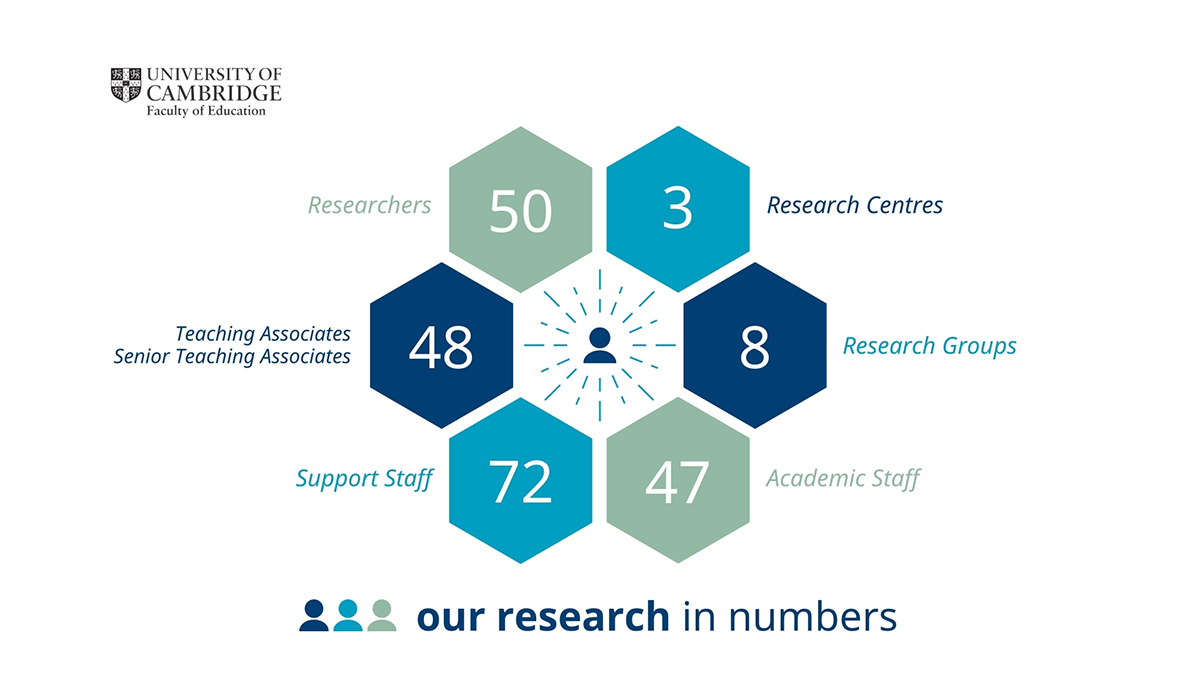
The Faculty of Education comprises:
- 48 Academic staff
- 47 Teaching Associates and Senior Teaching Associates
- 50 Researchers
- 72 Support Staff
- 8 Research Groups
- 3 Research Centres