Position/Status
Emeritus University Associate Professor
E-mail Address
ew208@cam.ac.uk
Qualifications
BSc, PGCE, (University of Bath)
MEd, PhD, (University of Cambridge)
CChem, FRSC, FHEA

Profile
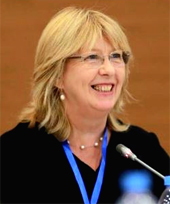
Dr Elaine Wilson was an Associate Professor at the Faculty of Education until September 2022, and is now an Emeritus Fellow of Homerton College at the University of Cambridge.
Elaine was a secondary school chemistry teacher in Bath and Cambridge and was awarded a Salters' Medal for chemistry teaching. She has also received two career awards for teaching in Higher Education; the University of Cambridge Pilkington Teaching Prize, in recognition of excellence in University teaching and a National Teaching Fellowship in recognition of excellence in teacher education leadership.
Elaine led the professional EdD doctorate programme at the Faculty of Education and continues to supervise international doctoral students. Her research interests are in Education Reform, Teacher Education and Wellbeing, and Digital Technology.
Between 2012 and 2017, Elaine led teams from Cambridge University and the Centre of Excellence, Nazarbayev Intellectual Schools in Kazakhstan to develop and implement a three-level in-service programme of teacher development and the head teacher leadership programme.
More recently Elaine has worked with teachers in India funded by the British Council and also developed a teacher led development programme in Romania funded by the World Bank. Elaine advises the Norwegian Research Council. She has appeared on a webinar for the Institute Social in Istanbul, about Empowering Teachers' Potential; risk and opportunities. Elaine has supported UNICEF and the Information and Analytical Centre in Kazakhstan with their learning loss study and has been part of the team compiling the UNESCO Global report on teachers.
Elaine’s ongoing projects include collaborating with colleagues at the University of Amsterdam, Waseda University in Tokyo, the Kazakh National Women's Teacher Training University and Abai University in Kazakhstan.
Research Interests
- Education Reform,
- Teacher Education and Wellbeing,
- Digital Technology.
Current Research Projects
Teachers' Professional Learning and implementing change in school systems
Doctoral Supervision
Doctoral Students Completed
Dr Aigerim Kopeyeva, PhD 2025 'Beyond the scores: A critical realist study of the causes of regional educational inequality in Kazakhstan'.
Dr Stephanie Hill, EdD 2025 '(Re)connecting Disconnections: the role of cogenerative spaces in our awareness of how learning is mobilised in schools'.
Dr Adam Barton, PhD 2024 'Making Sense of Educational Change: A longitudinal mixed-methods exploration of student & teacher reform enactment in Brazil'.
Dr Kamila Rollan, PhD 2023 'Engines, Paramedics, and Urban Madmen: Grounded theory study of engagement of NGOs in inclusive education reform in Central Asia.
Dr Ema Demir, PhD 2022 ‘Teacher Capital Unbound? The Role of Organisational Structures for Teacher Social Capital and Student Outcome’. Researcher, Center for Educational Leadership and Excellence, Stockholm School of Economics.
Dr Tom Harriot, EdD 2021 ‘An in-depth, naturalistic study of the regulation of learning in collaborative groups in upper secondary school classrooms.’
College Headteacher, Riddlesdown Collegiate.
Dr Tom Cowhitt, PhD 2021 ‘Star coalescence: A mechanism for school practitioners to leverage the relational infrastructure of educational improvement’.
Lecturer at the University of Glasgow
Dr Assel Sharimova, PhD 2021 ‘Understanding informal learning in virtual professional communities of teachers in Kazakhstan’.
Postdoctoral researcher Nazarbayev University, Astana, Kazakhstan
Dr Jude Brady, PhD 2020 ‘Workload, accountability and stress: A comparative study of teachers' working conditions in state and private schools in England’
Research Division Cambridge Education Partnership
Dr Jennifer Song, PhD 2017 ‘Digital technology use in higher education’
Educational consultant Seoul, S Korea
I will not be taking on any further doctoral students.
Selected Publications
See: scholar.google.nl/citations
Kazakhstan Teacher Education Reform and Implementation
Wilson, E. (2025). Recruiting new teachers for a changing world. Pedagogical Dialogue, 4. ISSN 2308-7668.
Berikkhanova, A., Wilson, E., Sarsenbayeva, L., Sapargaliyeva, B., Assilbayeva, F., & Iskakova, A. (2024). Leveraging Non-formal Action Research to Enhance Teacher Research Activity at a Pedagogical University in Republic of Kazakhstan. JURNAL ARBITRER, 11(4), 501–515. https://doi.org/10.25077/ar.11.4.501-515.2024
Berikkhanova, A., Sapargaliyeva, B., Ibraimova, Z., Sarsenbayeva, L., Assilbayeva, F., Baidildinova, D., & Wilson, E. (2023). Conceptualising the Integration of Action Research into the Practice of Teacher Education Universities in Kazakhstan. Education Sciences, 13(10), 1034. MDPI AG. Retrieved from http://dx.doi.org/10.3390/educsci13101034
Sharimova, A. & Wilson, E. (2022). Informal learning through social media: exploring the experiences of teachers in virtual professional communities in Kazakhstan. Professional Development in Education. First Online DOI: 10.1080/19415257.2022.2097291
Wilson, E., & Sharimova, A. (2019) Conceptualizing the implementation of Lesson Study in Kazakhstan within a Social Theory framework. International Journal for Lesson and Learning Studies, 8(4) https://doi.org/10.1108/IJLLS-08-2019-0060.
Элейн Уилсон, (2018). Қазақстандағы мектеп басшыларының дамуы. Мектепті басқару, Педагогикалық диалог журналының 4 (26).
ЭЛЕЙН УИЛСОН (2017). Ғылыми бағдарламаларды жетілдіру және іске асыру үдерісінде оқыту: Сингапур мен Қазақстандағы практикалық зерттеулердің үлгісі. ПЕДАГОГИКАЛЫҚ ДИАЛОГ ПЕДАГОГИЧЕСКИЙ ДИАЛОГ PEDAGOGICAL DIALOGUE 3 (21) , 52 – 60.
Ng, W.S.T. & Wilson, E. (2017). A Perspective of Teachers’ Appropriation of Educational Innovations, International Journal of Learning and Lesson Study,6 (3), pp.202-215.
Wilson, E. (2017). Bringing about change in schools; the case of Nazarbayev Intellectual Schools, Centre of Excellence Teacher and Leadership Programmes. Faculty of Education, University of Cambridge and Centre of Excellence, Nazarbayev Intellectual Schools, Kazakhstan.
Wilson, E. (2017). Alternative paths to upgrading existing teacher qualifications: the Kazakhstan- based Centre of Excellence Teacher Education Programme. In M.Hartley & A. Ruby, (Eds) Higher Education Reform and Development: The case of Kazakhstan. Cambridge, Cambridge University Press.
Turner, F., Brownhill, S. & Wilson, E. (2016). The transfer of content knowledge in a cascade model of professional development. Teacher Development.
Turner, F., Wilson, E., Ispussinova, S., Kassymbekov, Y., Sharimova, A., Balgynbayeva, B. & Brownhill, S. (2014). Centres of Excellence: Systemwide transformation of teaching practice. In D. Bridges, Educational reform and internationlisation. The case of school reform in Kazakhstan.Cambridge, Cambridge University Press.
Teacher Networks
Fox, A. & Wilson, E. (2015). Networking and the development of professionals: beginning teachers building social capital. Teaching and Teacher Education, 47, 93 - 107.
Fox, A., Wilson, E. & Deaney, R. (2011). Beginning Teachers’ Workplace Experiences: Perceptions of and Use of Support. Vocations and Learning, 4 (1) 1-24.
Fox, A., Deaney, R. & Wilson, E. (2010). Examining beginning teachers’ perceptions of workplace support. Journal of Workplace learning, 22 (4), 212-227.
Fox, A. & Wilson, E. (2009). "Support our networking and help us belong!": listening to beginning secondary school science teachers. Teachers and Teaching: Theory and Practice, 15 (6), 701-71
Teacher Education and Well-being
van der Lans, R., Daas, R., de Wal, J., Wilson, E., Inoue, N., Durksen, T. & Cornelissen, F. ( 2025).
Does education policy affect teachers’ learning needs? An international comparison of trends in teachers’ continuing professional learning needs in secondary schools in Australia, England, Japan and the Netherlands, British Education Research Journal. DOI: 10.1002/berj.70090
van der Lans, R., de Wal, J., Daas, R., Durksen, T., Inoue, N., Wilson, E. & Cornelissen, F. (2024). Beyond the linear standard: What circular models can teach us about teachers’ continuing professional learning needs in Australia, England, Japan and the Netherlands. Teaching and Teacher Education, 138, 104413
Wilson, E. & Brady, J. (2022) Wellbeing of School Teachers. In A. Giraldez - Hayes & J. Burke, (Ed.), Applied Positive School Psychology. Routledge .
Brady, J. & Wilson, E. (2021). Comparing sources of stress for state and private school teachers in England. Improving Schools, 1 -16.
Brady J. & Wilson, E. (2020). Teacher wellbeing in England: teacher responses to school-level initiatives. Cambridge Journal of Education, 51(1), 45 – 63.
Klassen, R., Wilson, E., Fiu, A., Hannok, W., Wong,M. & Wongsri, N. (2013). Work Stress and Occupational Commitment of Pre-Service Teachers in Four Countries: The Mediating Effect of Self-Efficacy. European Journal of Psychology of Education, 28 (4) 1289 - 1309.
Wilson, E. (2012) Building social capital in teacher education through university–school partnership. In M. Evans, (Ed) (2012)Teacher Education and Pedagogy: theory, policy and practice. Cambridge, Cambridge University Press.
Demetriou, H., Wilson , E. & Winterbottom, M. (2012) Perfection in teaching...settling for excellence. In M. Evans, (Ed) (2012)Teacher Education and Pedagogy: theory, policy and practice. Cambridge, Cambridge University Press.
Demetriou, H. & Wilson, E. (2012) It’s bad to be too good: the perils of striving for perfection in teaching. Procedia - Social and Behavioral Sciences, 46,1801 – 1805.
Wilson, E., Demetriou, H. & Winterbottom, M. (2010) Climate change: what needs to be done in order to motivate and sustain new teachers. Science Teacher Education, 57, 34-43.
Wilson, E. & Deaney, R. (2010) Changing career and changing identity: How do teacher career changers exercise agency in identity construction? Social Psychology of Education,13(2)169 - 183.
Demetriou, H. & Wilson, E. (2010) Children should be seen and heard: the power of student voice in sustaining new teachers. Improving Schools, 13, 1-16.Demetriou, H. & Wilson, E. (2008). A return to the use of emotion and reflection, The Psychologist, 21 (11).
Demetriou, H. & Wilson, E. (2009). Synthesising affect and cognition in teaching and learning. Social Psychology of Education: an International Journal, 12 (2) 213-232.
Demetriou, H., Wilson, E. & Winterbottom, M. (2009) The role of emotion in teaching: Are there differences between male and female newly qualified teachers' approaches to teaching? Educational Studies, 35 (4) 449-473.
Wilson, E. & Demetriou, H. (2007) New teacher learning; substantive knowledge and contextual factors. The Curriculum Journal, 18 (3) 213- 229
Wilson, E. (2005) Powerful pedagogical strategies in initial teacher education. Teachers and Teaching; theory and practice, 11 (4)1470-1478.
Demetriou, H. & Wilson, E. (2010) Children should be seen and heard: the power of student voice in sustaining new teachers. Improving Schools, 13, 1-16.
Education Policy
Wilson, E. (2015) Moving from Initial Education through the Professional Learning Continuum, the Role of Universities. In J. Simons (ed) The Importance of Teachers. A collection of essays on teacher recruitment and retention. Policy Exchange.
Wilson. E. (2010) Un "nouveau professionnalisme" des enseignants au Royaume-Uni. Former des enseignants (Teacher Training). Revue Internationale d'éducation de Sèvres, Issue 55.
Wilson. E. (2013) Higher Education Academy. Learning to teach; Supporting research-informed teacher education in a changing policy environment. Learning to Teach. https://www.researchgate.net/publication/257329997_Learning_to_teach
Wilson, E. (2012) Great teachers:attracting, training and retraining the best. Report the UK Parliament Education Select Committee. https://publications.parliament.uk/pa/cm201012/cmselect/cmeduc/1515/151502.htm
Demetriou, H. & Wilson, E. (2010) Student voice revisited: its power in sustaining new teachers. Department for Children, Schools and Families.
Pedagogical Content Knowledge and Technology
Childs, A. & Wilson, E. (2017) Chemistry Session Guides, 11 -13 and 14 -16. In I. Abrahms & M. Reiss, Enhancing learning with practical science 11- 16. London, Bloomsbury.
Martindill, D. & Wilson, E. (2015),"Rhetoric or reality? A case study into how, if at all, practical work supports learning in the classroom". International Journal for Lesson and Learning Studies, 4 (1) pp. 39 - 55
de Winter, J.A., Winterbottom, M. & Wilson, E. (2010) Developing a user guide to integrating new technologies in science teaching and learning: teachers' and pupils' perceptions of affordances. Technology, Pedagogy and Education, 19 (2) 261-267.
Research Methods
Cowhitt, T., Butler, T. & Wilson E. (2019). Using social network analysis to complete literature reviews: a new systematic approach for independent researchers to detect and interpret prominent research programs within large collections of relevant literature,
International Journal of Social Research Methodology. doi.org/10.1080/13645579.2019.1704356
Wilson, E. & Abibulayeva, A. (2017) An Introduction to Educational Research Methods (In Russian and Kazakh). Faculty of Education, University of Cambridge, Eurasian National University, Kazakhstan & The British Council.
Wilson, E. (2017) School-based Research: A Guide for Education Students. 3rd Edition. London, Sage.
Wilson, E. (2017) Action Research, in E Wilson, (Ed) School - based Research, London, Sage.
Wilson, E. (2004) Using activity theory as a lens to analyse interaction in a university - school initial teacher education and training partnership. Educational Action Research, 12(4)587-612.