

Overview of the course
This course option is only offered for University of Cambridge, Faculty of Education PGCE graduates
Trainees who successfully complete all examined elements of the Cambridge PGCE course can apply to undertake the part-time Master of Education (MEd) in just one year. If you completed your PGCE at another institution and would like to study part time please view our 2 year part time MPhil courses pages.
Faculty of Education PGCE trainees can:
- apply to start the MEd in the Michaelmas term following completion of their PGCE or
- take a maximum of a 3 year gap between completing the PGCE and starting the MEd - for example, if you complete your PGCE course in 2026 you can apply to join the MEd in one of the following academic years; 26-27, 27-28, 28-29 & 29-30.
- Please note, continuation onto the MEd from the PGCE is not automatic. PGCE students must submit an application by the advertised deadline. Applicants should note that there are limited places on this course and it may fill up well ahead of the advertised closing date and therefore, you are advised to apply early.
- PGCE-MEd admissions criteria:
• Demonstrate a background in the relevant subject (e.g. through prior academic study and/or relevant professional experience)
• Demonstrate a research interest in the route applied to
We offer our students:
We aim to support our students to develop:
Visas for part time study
If you are an international applicant wanting to study part time, it may be possible for the University to sponsor you for a visa. Please see our visa webpage for further information.
 Choosing your course
You should select a course from the list below that reflects your current and future interests:
(The Educational Policy, Leadership and Improvement route is not available as 1 year part-time PGCEM course, but can be taken as 2 year part-time MPhil course).
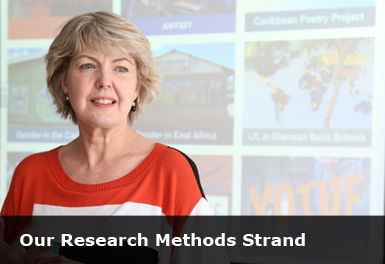 Our Research Methods Strand
The research strand covers a broad range of social science research methods and is essential for Masters level understanding and critical engagement with the research literature in many specialist areas and in education more generally.
It offers opportunities and encouragement to apply the knowledge gained to your thematic area, and vice versa. Masters students on the majority of routes are required to attend a generic research methods strand, taught across thematic routes.
 Personal Supervision
One of the great strengths of studying at Cambridge is the level of individual support you will receive.
You will be assigned an expert in your field to guide you through your course. You will meet with them regularly to discuss progress and will be able to send them your work for feedback and advice.
The Faculty has around forty academic staff teaching on the Graduate programme offering a very wide range of expertise. PGCE-MEd students are entitled to 4 hours of supervision.
 Session Times for the Thematic Courses
For all courses, except Transforming Practice, sessions will start at 2pm on a Wednesday and continue to run through school half terms. There is some variation in the duration of sessions across courses that meet on Wednesdays.
Transforming Practice students will follow a weekly online model of work with around 5 conferences, usually on a Saturday (the induction is on a Friday).
If you require further details, please see the course pages above or contact the course coordinator.
 How to Apply
Applications for the PGCEM course are managed centrally by the Postgraduate Admissions Office.
Applications are considered in three batches; firstly after the 2nd December 2025 and then after the 26th February 2026 and finally the application deadline of 14th May 2026. It is possible that some applications from the early batches are held for consideration in further batches.
Please note some routes may fill up well ahead of the advertised closing date. You are advised to apply by the December deadline if possible. We aim to make decisions on applications within 12 weeks of the applicable application batch deadline.
You are not considered a 'continuer' for the purposes of this application as you are previously registered as a 'postgraduate' and not a 'graduate'. You should follow the instructions as if you were a new applicant.
Admissions process
During the admissions process you will also hear from the Faculty and your College. Please view this PGCE to MEd Admission process overview for further information about what to expect from each department and who to contact for specific queries.
Application form
The application form is a generic form used across the whole university for a number of programmes so some sections are not applicable to PGCEM applicants - please view this step by step guide on what to submit on your application.
Self-service account
You will be given access to a self-service account please ensure you note your email address correctly and check for updates regularly as important information and actions will be sent you periodically. You are responsible for checking what actions and information is required to submit via your self-service account - please check you can access regularly.
 Application deadlines
Applications from students who wish to commence the PGCE-MEd in October 2026 will open in September 2025.
Please be aware that students can take a maximum of a 3 year gap between completion of the PGCE and completing the MEd.
You are advised to apply by December of the year prior to when you wish to start. Some applications may be considered in early batches may be carried over to be considered further in later batches.
The Faculty will not accept applications submitted after the deadline and can not offer further places once a route is full.