
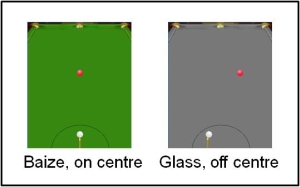
Horizontal motion was examined via computer-simulated billiards scenarios, where a cue struck a white ball, which then rolled and struck a red ball. The scenarios varied in whether the white ball was struck hard or gently and on- or off-centre, and whether the motion was over glass or the normal baize surface (see Figure 1). Real cues, balls, baize surface and glass surface were available for handling during task administration. To examine explicit understanding, the scenarios froze at the point of impact between the white and red balls, and the task was to predict the subsequent direction (Study 1A1) or acceleration/deceleration (Study 1A2) of one or other ball. To examine tacit understanding, the motion continued after impact, sometimes in a natural fashion (e.g. the red ball fell into the correct pocket on the table or slowed down as it rolled) and sometimes in a non-natural fashion (e.g. the red ball fell into an incorrect pocket or speeded up). The task was to judge whether the direction (Study 1A1) or speed (Study 1A2) was correct.
Figure 1: Sample Scenarios
The studies were conducted with primary school children from Year 2 (aged 6 to 7 years), Year 4 (aged 8 to 9 years), and Year 6 (aged 10 to 11 years). A randomly selected 50% of the children at each age level began with the explicit task (16 scenarios), with the remaining 50% starting with the tacit task (16 natural motion scenarios plus 16 non-natural motion). There was a two-week interval between tasks. There were two blocks of scenarios within each task, one block relating to the red ball’s motion and the other block relating to the white ball’s motion. Order of blocks was randomized across children, as was order of scenarios within blocks. The tasks were presented on Dell Latitude D820 laptops, which recorded decisions and time to respond. The children completed the tasks in one-to-one sessions with a researcher, who offered procedural guidance. At the end of whichever task came first, the researcher took the children through questionnaires that examined their familiarity with computers and billiards. Questionnaire results were unrelated to task performance.
In Study 1A1, complete datasets (i.e. explicit and tacit) were obtained from 49 Year 2 children (25 girls; Mean age = 6.12 years), 47 Year 4 children (18 girls; Mean age = 8.26 years), and 45 Year 6 children (28 girls; Mean age = 10.20 years). Strong negative correlations between accuracy of decisions and time to respond meant that results were identical whichever measure was used. Focusing on decisions (predictions for the explicit task and judgments for the tacit task), the main findings were:
- Tacit understanding was generally good, with the children accepting 84% of the scenarios that showed natural direction as correct, and rejecting 60% of the scenarios that showed non-natural direction as incorrect.
- Tacit task performance with non-natural direction improved with age, such that by Year 6 it was indistinguishable from performance with natural direction. Errors on the tacit task were more likely to reflect task perceptibility than lack of tacit understanding, e.g. they were clustered around scenarios that depicted motion with hard force on a glass surface.
- On the explicit task, the children were generally good at predicting which pocket the red ball would roll into, but poorer at predicting the white ball’s direction after impact with the red ball.
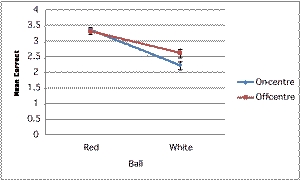
- Errors with the white ball were especially frequent after on-centre impact (see Figure 2), where the children often expected the white ball to bounce backwards. Yet with the tacit scenarios, they displayed good understanding of the white ball’s actual direction after on-centre impact, i.e. forwards with the same trajectory as the red ball.
Figure 2: Effects of ball and angle (Study 1A1 explicit)
In Study 1A2, data relating to each of the two tasks were obtained from 38 Year 2 children (23 girls; Mean age = 6.10 years), 46 Year 4 children (20 girls; Mean age = 8.24 years), and 48 Year 6 children (17 girls; Mean age = 10.20 years). As with Study 1A1, the two measures (decision accuracy and response time) led to similar conclusions, and therefore only decision accuracy data are summarized:
- Performance on the tacit task was well above chance levels (chance = 50%), with accepting natural (decelerating) speed as correct (71% success rate) and rejecting non-natural (accelerating) speed as incorrect (65% success rate). Most errors can be attributed to difficulties with motion perceptibility rather than lack of tacit understanding.
- On the tacit task, the Year 2 children performed below the Year 4 and Year 6 children (who did not differ) with both natural and non-natural patterns of speed. The Year 2 children were more successful with natural speed than non-natural, while the older children were equally successful with both types.
- The children only achieved 43% success on the explicit task, with most errors indicating an expectation that the balls would roll with constant speed.
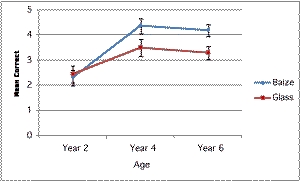
- Performance improved with age on the explicit task when the baize surface was used (see Figure 3), suggesting increasing awareness of surface friction when the surface was perceptibly rough. On the tacit task, all children took friction into account regardless of surface.
Figure 3: Effects of age and surface (Study 1A2 explicit)