
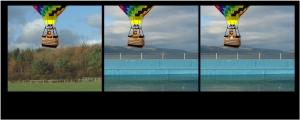
Object fall was addressed via computer-simulated hot air balloon scenarios, where a ball was dropped from the balloon (see Figure 4). Three balls featured in the scenarios (small light, small heavy, large heavy), with the real equivalents available for handling during task presentation. Scenarios also varied over whether the balloon was stationary or moving at the point that the ball was released, and whether the ball fell through air alone or through air and water. To examine explicit understanding, the scenarios froze at the point of release, and the task was to predict the ball’s subsequent direction (Study 1B1) or speed (Study 1B2). To examine tacit understanding, the ball fell, sometimes in a natural fashion (e.g. in a forward parabola when the balloon was moving) and sometimes in a non-natural fashion (e.g. vertically or backwards when the balloon was moving). The task was to judge whether the direction (Study 1B1) or speed (Study 1B2) was correct.
Figure 4: Sample scenarios
The studies were conducted with primary school children from Year 2 (aged 6 to 7 years), Year 4 (aged 8 to 9 years), and Year 6 (aged 10 to 11 years). A randomly selected 50% of the children at each age level began with the explicit task (12 scenarios), with the remaining 50% starting with the tacit task (12 natural motion scenarios plus 12 non-natural motion). There was a two-week interval between tasks. There were two blocks of scenarios within each task, one block relating to fall through air only and the other relating to fall through air and water. Order of blocks was randomized across children, as was order of scenarios within blocks. The tasks were presented on Dell Latitude D820 laptops, which recorded decisions and time to respond. (Analyses of decisions only are summarized below, due to equivalence of findings across measures). The children completed the tasks in one-to-one sessions with a researcher, who offered procedural guidance. At the end of whichever task came first, the researcher took the children through questionnaires that examined their familiarity with computers. The main findings were independent of questionnaire results.
With Study 1B1, the sample completing both the explicit and the tacit task comprised 45 Year 2 children (15 girls; Mean age = 6.69 years), 45 Year 4 children (21 girls; Mean age = 8.82 years), and 47 Year 6 children (20 girls; Mean age = 10.85 years). Across the sample, performance was sharply differentiated as a function of whether or not there was pre-fall motion, as well as whether the task was tacit or explicit:
- When the balls fell from rest, performance on the tacit task was close to ceiling level, regardless of whether the direction was natural (i.e. vertical) or non-natural (i.e. parabolically forward or backward).
- When the balls fell after pre-fall motion, 55% of scenarios were judged accurately on the tacit task. Again, success rates were not heavily influenced by whether the direction was natural (i.e. parabolically forward) or non-natural (i.e. vertical or parabolically backward). However, when the children erred with non-natural motion, it was almost always toward accepting vertical fall as correct. Backward fall was seldom accepted.
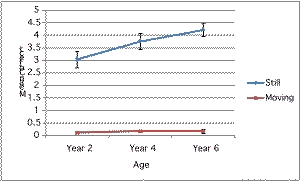
- When the balls fell from rest, performance on the explicit task improved with age from 51% correct in Year 2 to 70% in Year 6 (see Figure 5). At all age levels, errors were as likely to involve predicting forward fall as backward fall.
- When the balls fell after pre-fall motion, only 2% of responses were accurate, and there was no improvement with age (see Figure 5). On the other hand, amongst the Year 2 children, 20% of responses predicted backward fall, 45% predicted vertical fall, and 35% predicted forward (albeit non-parabolic) fall. By Year 6, the figures were 58% backward fall, 29% vertical fall, and 13% forward fall. Thus, backward fall increased in frequency with age on the explicit task, even though it was seldom accepted as correct on the tacit task.
Figure 5: Effects of age and motion (Study 1B1 explicit)
In Study 1B2, the sample completing both tasks comprised 37 Year 2 children (23 girls; Mean age = 6.84 years), 49 Year 4 children (23 girls; Mean age = 8.88 years), and 47 Year 6 children (26 girls; Mean age = 10.80 years). The main findings were:
- On the tacit task, 61% of responses accurately accepted acceleration and rejected deceleration when the balls fell through air alone. This is well above what would be expected by chance. However, only 54% accurately accepted deceleration upon impact with water and rejected acceleration. It is likely that this latter figure is artificially deflated through difficulties that the children experienced when there was pre-fall motion.
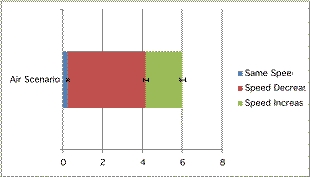
- On the explicit task, the modal response at all age levels was to predict deceleration during fall through air (see Figure 6), leading to very low success rates (only 31% across the sample). Deceleration was also predicted (this time correctly) on 50% of scenarios when the balls fell from air into water.
Figure 6: Predictions relating to fall through air (Study 1B2 explicit)