
The BA in Education - Number 1 in the UK
The Guardian - Rated a perfect 100
The Times - Rated a perfect 100
Complete University Guide - Scored 100%
BA in Education Taster Lecture - AI in Education - Thursday 21st May 5pm
The BA in Education is a rich, varied and fascinating study of humanity. It intersects with a wide range of subjects such as drama, history, philosophy, sociology, economics, politics, English, and more. Students on our course consider a multitude of pertinent questions around social justice, inequality, technology, the role of institutions, and how all of these impact the human experience of learning.
The Faculty of Education is hosting a series of taster lectures for potential students to get a flavour of the breadth and variety of the degree.
AI in Education: How it Works, What it Changes, and Why it Matters
The taster session will explore what AI is, how generative AI works, where it is showing up in Education and what the key issues are for students, including fairness, trust and who benefits or loses from AI.
This lecture will be delivered by Steve Watson. He is an Associate Professor in Transdisciplinary Studies at the Faculty of Education. Alongside research and innovation, Steven is an active public speaker and commentator. He contributes regularly to international debates on AI, education, and democracy, with appearances on BBC Radio and invited lectures at leading universities and forums worldwide, including Tsinghua University, Davos, and the World Economic Forum. His forthcoming essay on trust and social systems, for a special issue of Kybernetes, extends Autopoietic Ecology to contemporary democratic challenges.
It is free and aimed at Year 11 and 12 students. Parents, guardians and teachers are also welcome to attend.
The event is online will last approximately one hour.
To book onto this event, register here
The BA in Education - a different way of looking at the world.
Want to be the first to hear about our upcoming Education events?
We run a programme of information events and taster lectures that explore our BA in Education from December to June each year, ending with our Open Days in July.
Sign up to our mailing list to be notified about upcoming events here
Overview of the BA in Education
The BA in Education is a three year undergraduate degree course. This flexible interdisciplinary programme offers a broad, compulsory introduction in year one, followed by the opportunity to select papers across a range of disciplines, or to focus more closely on a particular area you may be interested in exploring in more depth.
The course has been ranked the number 1 course in education in the UK for several years running by the Complete University Guide.
Attendance
- approximately four to six lectures and seminar
- plus one or two hours of supervision per week
Assessment
You are assessed at the end of each year. Depending on the papers studied, this will be thorough practical work, coursework, written examination, or a combination of these. In the third year, all students also submit a dissertation
Find out more about the course structure, how to apply or contact us for further information.



Where can the BA in Education take you?
Higher Education
Our course provides excellent preparation for a wide range of Masters degrees and doctoral research programmes at Cambridge and elsewhere.
Initial Teacher Training (ITT)
Alternatively, for those intending to teach, the course provides a foundation from which to proceed to initial teacher training in primary education.
Career options for graduates
The career options for graduates are extremely varied and they find employment in a wide range of occupations in the UK and abroad. As well as further study and teaching, our students have gone into research, educational research and neuroscience publishing, and the Civil Service. Others now work in government policy and administration, the media, theatre, heritage and museum education, HR, business and consultancy, charities and NGOs, and international development.
The Careers Service runs a number of events exclusively for Cambridge students, giving students the opportunity to develop their employability skills and meet potential employers:
- Graduate Schemes and Internships Event
- Consultancy Event
- Careers in Creative Industries Event
- Work to Change the World Event
- Skills and briefing sessions
- Careers panels and talks (e.g. Careers Briefing: ‘I don’t want to work in the City!’)
- Employer-led skills sessions (e.g. sessions on how to tackle Assessment Centres for careers in the not-for-profit sector)
Facilities
The Donald McIntyre Building
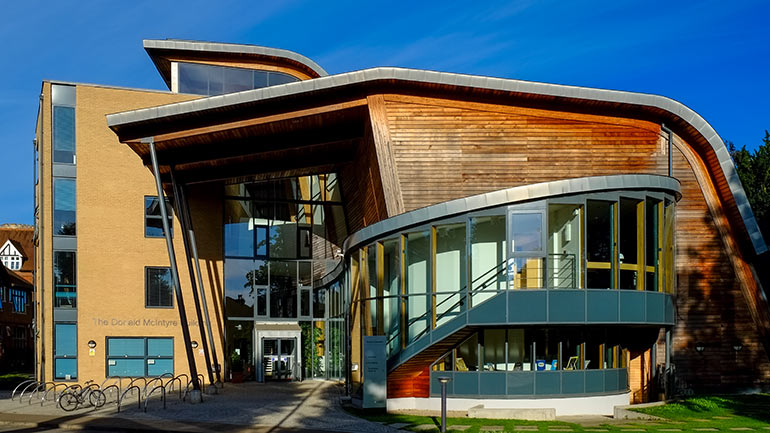
The home of the Faculty of Education, the Donald McIntyre building has a variety of classrooms and computer rooms, as well as a PhD room for our doctoral students and a observation laboratory for the use of our Research Groups. This is also where you'll find the Undergraduate and PGCE office, IT services, AV services and the Library.
The Library
The Education Library supports the Faculty’s seven teaching programmes and three world-leading research centres. The Library has 58,000 physical items, over 100 study spaces, a curate online library of thousands of ebook titles, tailored library guides, plus a knowledgeable team with extensive experience in supporting Education students.
Undergraduate Open Days
The University runs undergraduate Open Days throughout the year. Check back here to keep up to date on when we’re running our next series of events, or find out more, head to the Cambridge Open Days page.