
“I'll never forget my time on the course, and I wish I'd known what I learnt here long ago.”
“Absolutely phenomenal experience - couldn’t have been taught any better than this.”
“The course exceeded my expectations, I didn’t want it to end.”
This is an exciting and innovative course that offers the opportunity to explore creative interventions and to develop skills in effective communication with children and young people. Participants have described the Introduction course as ‘transformative’ on both a personal and professional level.
Taught at the Faculty of Education, this course offers you an opportunity to upskill and explore if a career in psychotherapy or a related field is the next step for you.
Course summary
Taught at Master's Level 7, Psychotherapeutic counselling emphasises the co-creation of an in-depth therapeutic relationship that aims to facilitate growth and alleviate distress.
Course overview
The course is taught over six weeks and is a 32-hour PAES Introductory programme. It explores psychotherapeutic counselling with children and adolescents with a focus on play and the arts. It offers activities to develop the skills and theoretical base for those who work or volunteer in this field.
Students are encouraged to consider how these skills apply in their own work setting, through the idea of ‘embedded counselling’. There is an emphasis on the therapeutic relationship and the relational processes involved in using counselling skills with children and young people.
Consideration will also be given to specific areas including:
- counselling in schools and other settings;
- Attachment theory and Psychotherapeutic concepts;
- safeguarding and child protection including Adverse Childhood Experiences;
- working with diversity and ethical issues;
- Understanding the systems around the child and aspects of child psycho-social development;
- The course takes an Integrative approach combining Humanistic and Psychodynamic theories and concepts with play and the arts.
Learning Outcomes
By the end of this course students will be able to:
- Name and describe key theories and concepts in psychotherapeutic counselling with children and young people;
- Have a basic understanding of traditional attachment theory and neurobiological ideas;
- Be able to describe the nature of a therapeutic relationship and why relationship is at the heart of the therapeutic work;
- Be familiar with a range of creative interventions to support effective communication with children and adolescents;
- Increase personal and professional self-awareness and reflexivity.
Teaching Methods
The course is taught through an active learning approach that centres on experiential work. Teaching also takes place through:
- interactive workshops
- mini lectures
- group discussions
- practice sessions with peer and tutor feedback
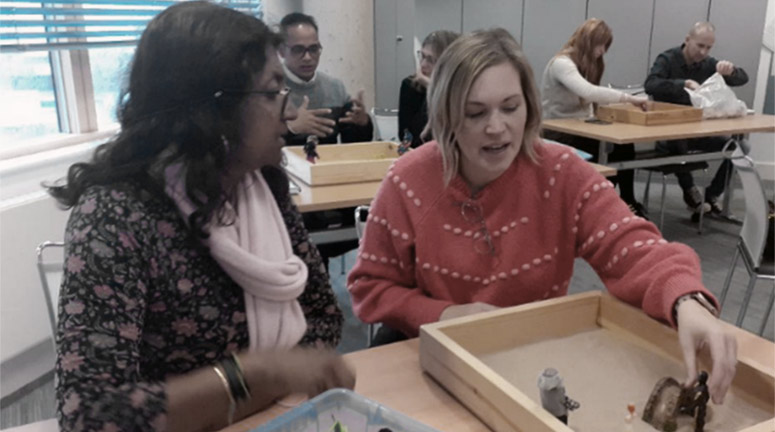
- practice sessions involving arts and play
- student presentations
This course is taught in person at the Faculty of Education, Cambridge.
Safeguarding
The University of Cambridge is committed to safeguarding and promoting the welfare and safety of children. In all aspects of the Counselling course provision, including the recruitment of trainees, we adhere to relevant aspects of Keeping Children Safe in Education, and of relevant legislation, and expect all members of our community to fully commit to their associated responsibilities to the safeguarding of children, young people and vulnerable adults.
Who is this course aimed at?
This course is aimed at adults working with young people and children, who want to begin to develop some counselling skills and knowledge. It is appropriate for those working directly with children and young people in education or other settings such as youth work, health, or social care.
Students attending this course may wish to apply for the Postgraduate Diploma in Child and Adolescent Psychotherapeutic Counselling, which is a nationally accredited psychotherapeutic counsellor education programme. However, please be aware that progression from the Introduction course to the Postgraduate Diploma is not a guaranteed route, as they are two separate courses.
Entry qualifications
No previous counselling education is required although this is a postgraduate award and normally candidates are expected to hold a good honours degree.
Award
Postgraduate Award in Educational Studies (PAES) - 30 credits
How is the course assessed?
- A 2000-word equivalent assignment, delivered via a presentation;
- A 2000-word synthesis of your learning journal. Students are expected to keep a learning journal for the duration of the course and will need to hand this in.
Who is teaching it?
Esther Hunt is the Course Tutor and Oktober Evennett is the Route Coordinator for the Introduction Course. Students are supervised in learning groups to help them prepare for the assessment.
Cost
| Tuition Fees for 2026/27 | ||||
|---|---|---|---|---|
| Home Students | £1760 | |||
| Overseas Students (including EU) |
£4745 | |||
Please note: Fees are reviewed every year and may increase in subsequent years.
Course availability
The course usually runs twice each academic year, once in Michaelmas term (starting in October) and once in Lent term (starting in January).
The course is taught over 6 weeks, either side of the Cambridgeshire schools half term, with an additional assessment day two weeks after the final teaching day.
Students on the Michaelmas 2026 course are expected to attend on all of the following dates:
| Course Dates - Michaelmas 2026 start | ||||
|---|---|---|---|---|
| Day | Date | Time | ||
| Wednesday | 7 October 2026 | 10.30-16.30 | ||
| Wednesday | 14 October 2026 | 10.30-16.30 | ||
| Wednesday | 21 October 2026 | 10.30-16.30 | ||
| HALF TERM BREAK | ||||
| Wednesday | 4 November 2026 | 10.30-16.30 | ||
| Wednesday | 11 November 2026 | 10.30-16.30 | ||
| Wednesday | 18 November 2026 | 10.30-16.30 | ||
| BREAK | ||||
| Wednesday* | 2 December 2026 | 10.30-16.30 | ||
*In addition to the teaching days, students must be available on 2 December 2026, when all students will deliver their presentations.
Students on the Lent 2027 course are expected to attend on all of the following dates:
| Course Dates - Lent 2027 start | ||||
|---|---|---|---|---|
| Day | Date | Time | ||
| Wednesday | 24 January 2027 | 10.30-16.30 | ||
| Wednesday | 3 February 2027 | 10.30-16.30 | ||
| Wednesday | 10 February 2027 | 10.30-16.30 | ||
| HALF TERM BREAK | ||||
| Wednesday | 24 February 2027 | 10.30-16.30 | ||
| Wednesday | 3 March 2027 | 10.30-16.30 | ||
| Wednesday | 10 March 2027 | 10.30-16.30 | ||
| BREAK | ||||
| Wednesday* | 24 March 2027 | 10.30-16.30 | ||
*In addition to the teaching days, students must be available on 24 March 2027, when all students will deliver their presentations.
How to apply
Please see the separate application page for the application requirements and the link to the application form.
Interviews for the 2026-27 courses will take place on Wednesday 27 May 2026, Wednesday 22 July 2026 and Wednesday 28 October 2026. Like the course itself, the interviews are held in person at the Faculty of Education, Cambridge.
Any course queries should be directed to ppd-admissions@educ.cam.ac.uk.