Unlocking the Potential of Bilingual Learners through Collaborative Partnerships and Systems Convening
Mission
Our mission is to mobilise and convene linguistic and cultural heritage across homes, schools, communities, universities and memory institutions, empowering bilingual learners to flourish in their languages throughout their lives."
About Us
CRiCLE-Net was established in 2014 as a research initiative supported by the Newton Fund. Based within the Faculty of Education at the University of Cambridge, it provides a dynamic research forum where practitioners, research students, academics and policy makers, both locally and internationally, can engage in critical debates surrounding language, heritage and migration.
The term ‘community/heritage languages’ refers to a wide range of languages that co-exist alongside dominant national language(s) and are often used within homes, cultural and religious groups, or diaspora communities. In the UK context, these include, for example, Arabic, Bengali, Catalan, Cantonese, Farsi, Greek, Gujarati, Hebrew, Hindi, Hungarian, Italian, Lithuanian, Japanese, Korean, Mandarin, Persian, Polish, Portuguese, Punjabi, Russian, Spanish, Somali, Swahili, Tamil, Turkish, Urdu, Yoruba, among many others. In Cambridge, there are 33 community-led heritage language schools and programmes operating on weekends, serving more than 2500 bilingual children across the region.
Research in this area emerges in response to transnational migration and the growing needs of immigrant communities to preserve their heritage languages and cultures. Across different contexts, such research has been conducted under a variety of terms: 'asset language' in England, ‘community language’ in Australasia and the UK, 'home language' in Africa, 'heritage language' in the Americas, 'mother tongue' in Asia, 'migration language' in Europe, and 'refugee language' in conflict zones. In the UK and internationally, community/heritage language education has recently gained prominence as a field of scholarly inquiry. There remains a critical need for dedicated initiatives that examine the education and experience of heritage language learners and support the maintenance of their languages across the lifespan.
Vision
To establish a Local Community Partnership, a Regional Support Network, and a Global Research Consortium aimed at promoting the benefits of multilingualism for the education, integration and wellbeing of bilingual children and youth from heritage-language backgrounds
Aims
The CRiCLE-Net has both an international and a local focus and pursues an interdisciplinary approach to policy, theory and practice of community language education.
We work with children, engage the community, and collaborate through partnerships."
Our research generates evidence, informs policy, and transforms practice."
The aims of CRiCLE-Net are:
- To provide a research forum where policymakers, academics, practitioners and research students can exchange ideas and expertise in community/heritage language education;
- To collaborate with local, regional, national and international institutions to identify critical issues in community/heritage language education, engaging in theoretical and methodological debate on these issues;
- To develop a corpus of research evidence to inform and guide the development of policy and practice in community/heritage language education;
- To foster interdisciplinary connections and promote cross-fertilisation among fields including Applied and Educational Linguistics, Bilingual and Multilingual Education, Second and Foreign Language Education, Community and Heritage Language Education, Minority and Indigenous Language Education, Language and Literacy across the Curriculum, and Teaching English to Speakers of Other Languages (TESOL) and Languages Other than English (LOTE).
Governance
The governance of the network is supported by an Executive Committee, an International advisory panel, a School Diversity Advisory Board and a Working Group. In addition to providing strategic oversight, the network actively supports local schools and communities and serves as a research resource centre for community/heritage language education both in the East of England, and nationally and internationally.
Collaboration
Members of the CRiCLE network are well connected to the University's interdisciplinary research initiatives on Migration, Language Sciences, Refugee Studies and Heritage Research.
Language, Heritage, Migration Initiative
Cambridge Refugee Hub
Refugee Language Education Unit
Centre for the Study of Global Human Movement
Cambridge Language Sciences Interdisciplinary Center for Language Sciences
Center for Science and Policy (CSaP)
Cambridge Heritage Research Centre
Partnerships
CRiCLE collaborates closely with local community schools and Cambridge Bilingual Groups, a volunteer support organisation that provides hands-on training and professional development for community language teachers and step-by-step guidance to help ethnic communities establish community language schools. For the latest updates on community language education, follow Cambridge Bilingual Groups on Facebook.
Through a multi-stakeholder partnership, we recently launched the inaugural Cambridge Community School Leadership Forum designed to facilitate rapid policy consultation and coordination of local support for community language education.
We have also established a distinctive partnership model, the Cambridge Heritage Language Education Partnership - to support heritage-language children and their parents. This initiative brings together CRiCLE, Cambridge Bilingual Groups, Cambridge Ethnic Community Forum, Cambridge Refugee Hub, Centre for the Study of Global Human Movement, Cambridgeshire Libraries, Cambridge Central Library, and Norfolk County Council EAL/EDC Service.
We have a long-standing partnership with the Bell Foundation working on research and development projects on EAL teaching and assessment in schools.
We worked in partnership with Association for Language Learning (ALL), National Association for Language Development in the Curriculum (NALDIC), and Cambridgeshire County Council in the education strand of the AHRC/OWRI project on multilingualism and language policy (MEITS) and the campaign of 'We are Multilingual' (WAM) which forms part of the legacy of the education strand of the project. Follow project updates on blogs, news, events and Twitter.
Research Programmes
Members of CRiCLE have been involved in a range of projects within five research programmes, each with a distinctive theme:
- Strand 1: English as an Additional Language (EAL)
'The Cambridge EAL (CamEAL) Research Programme' (Bell Foundation) - Strand 2: Multilingualism and MFL Learning in Schools
'Multilingualism: Empowering Individuals, Transforming Societies (MEITS)' (AHRC/OWRI Large Grant, Education Strand) - Strand 3: Home/Heritage/Community Language Education (HHCL)
Linguistic Capital in the Community: Reimagining Complementary Schooling' (Centre for the Study of Global Human Movement) - Strand 4: Bilingual/Multilingual/Intercultural Education
'Defining the Knowledge Base of CLIL Teaching in Multilingual Primary Education Settings' (British Council Report)
Conceptualising Assessment Literacy of Teachers in Content and Language Integrated Learning Programmes (Hong Kong Research Grants Council/HKU, International Partner) - Strand 5: Language(s) and Literac(ies) in Development and Refugee Contexts
'The Learning Passport' Programme (Cambridge/Unicef/Microsoft)
'Language, Integration and Media: A Majority-inclusive Approach to Migration' (Research Council of Norway, International Partner)
Impact
Refugee Language Education Unit, Cambridge Refugee Hub
Cambridge Multilingual Storytime, in collaboration with Cambridgeshire Libraries, Cambridge Central Library and Cambridge Bilingual Groups
Cambridge Community School Leadership Forum under the auspices of the Centre for the Study of Global Human Movement
Cambridge Heritage Language Education Partnership, involving CRiCLE, Cambridge Ethnic Community Forum, Cambridge Bilingual Groups, Cambridge Refugee Hub, Cambridgeshire Libraries, Cambridge Central Library, Norfolk County Council EAL/EDC Advisory Service, Centre for the Study of Global Human Movement
EAL Assessment Framework for Schools (2.0) and the Digital Tracker, in collaboration with the Bell Foundation
We Are Multilingual (WAM), MFL open resources as part of the legacies of the AHRC MEITS Project
Language Policy Forum (LPF) 2020, under the sponsorship of the Language Policy SIG of BAAL
Cambridge Masterclasses on Multilingualism, Education and Language Policy, hosted by SLEG
Cambridge Distinguished Lecture Series in Second Language Learning and Teaching, hosted by SLEG
Research Approaches
Research Domains
Languages at home, Languages for schooling, Languages in the community, Languages for work, Languages for Education in Emergencies
Research Dimensions
*** The Role of Heritage Language Schools ***
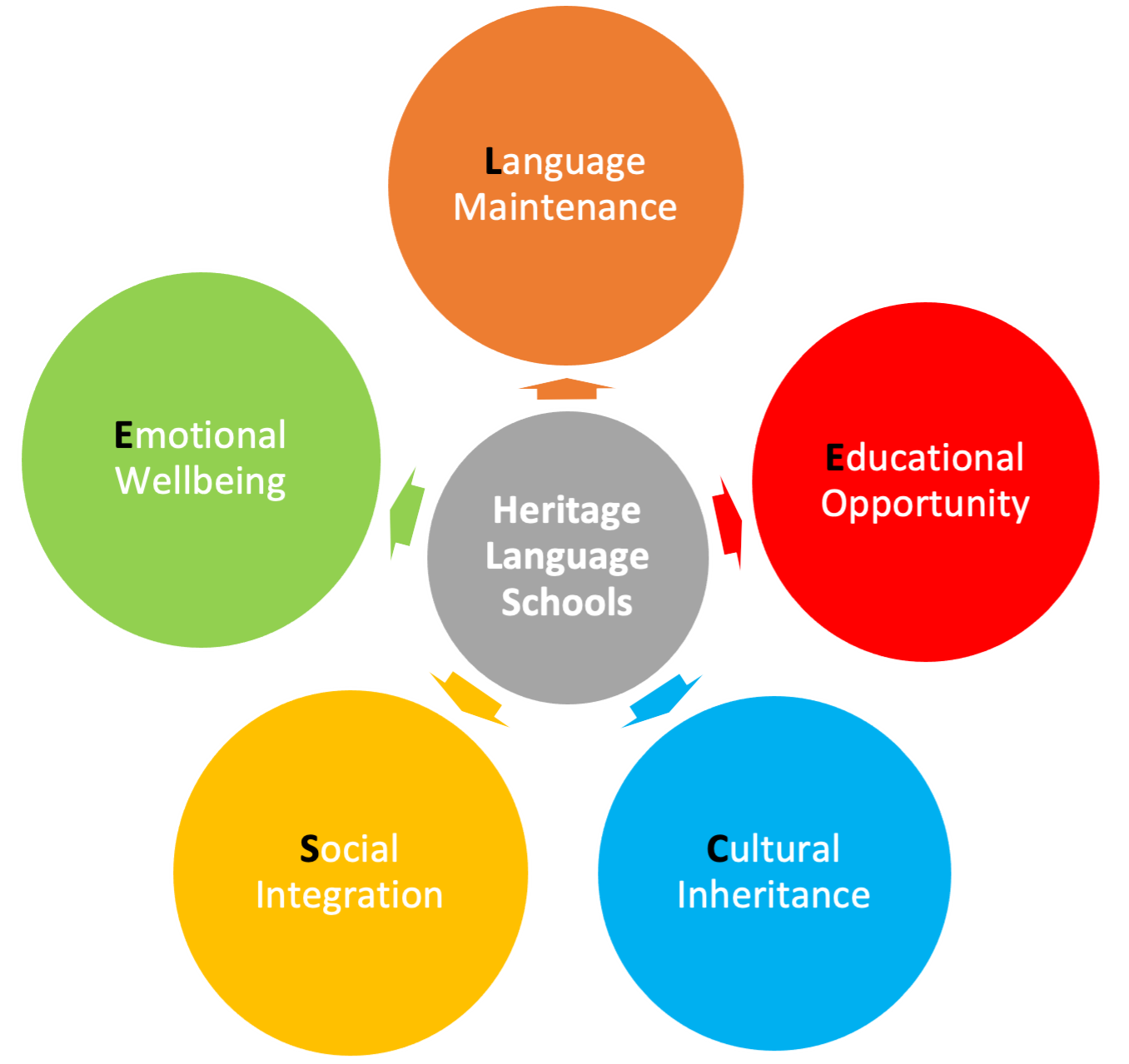
In Liu, Y., & Hoare, L. (2023). Complementary schools as heritage language communities of practice: Reaching beyond language maintenance. In H. Pinson, N. Bunar & D. Devine (Eds.) Research handbook on migration and education (pp. 203-220). Cheltenham, UK: Edward Elgar Publishing.
*** Heritage Language Learning and Wellbeing ***
Zhou, Y., & Liu, Y. (2024). A “positive” turn in heritage language education: Multilingual children's voices on language learner well-being. System, 125, 103446. https://doi.org/10.1016/j.system.2024.103446
Zhou, Y., & Liu, Y. (2024). Language learner well-being in heritage language learning: conceptualisation, measurement, and a pathway to flourishing. International Journal of Bilingual Education and Bilingualism, 1–17. https://doi.org/10.1080/13670050.2024.2419428
Teaching and Learning Programmes
CRiCLE students and alumni are all members of the Multilingualism and Language Education (MuLtiE) Group in the Faculty which provides an intellectual home for students and staff researching on second, foreign, heritage and additional language/literacy education. The MuLtiE research group also hosts or involves in a range of teaching and learning programmes including:
PhD/EdD in Language and Education (LAE)
MPhil/MEd Research in Second Language Education (RSLE)
MEd Transforming Practice Thesis Projects on Modern Languages in School (TP)
PGCE in Modern Languages (MFL)
Education Tripos (Undergraduate) Research and Investigation Projects on Language Education (R&I)
Education Tripos (Undergraduate) Core Paper in Language, Communication and Literacies (LCL)
PPD Certificate/Diploma Projects on English as an Additional Language (EAL)
Bespoke Professional Development Workshops for Community Language Teachers (CLT)
Visiting Scholar and Visiting Student Programmes
Logo designed by David Almeida with the assistance of Clare Yerbury