Guiding Playful Learning and improving children's outcomes in early education
Developing and testing new theory-driven pedagogical approaches for early childhood classrooms.
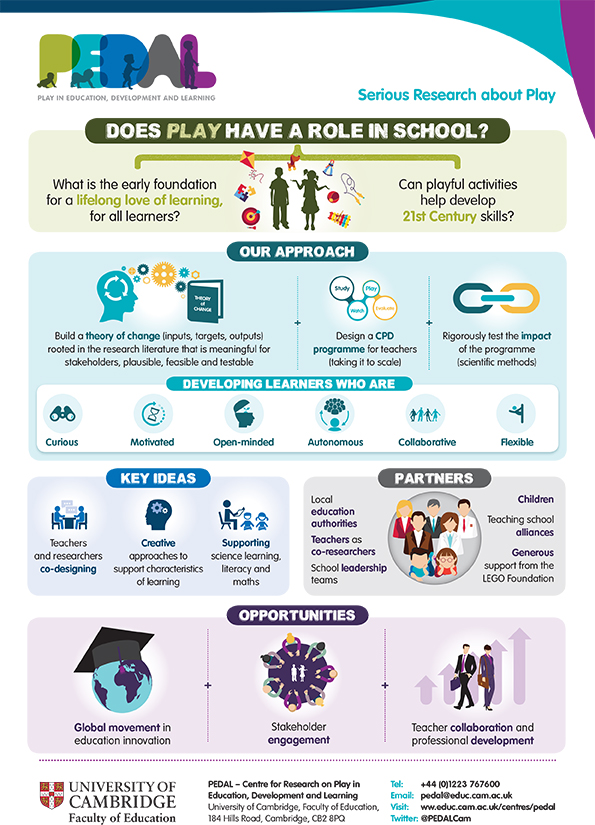
Please click on our infographic image for more details.

Purpose
There is a growing demand for children to master “21st century skills” – to be independent thinkers and problem-solvers. How can schools foster these skills, while still providing a playful environment for learning? With the help of children and teachers, we aim to make a powerful contribution to the development of high quality early childhood education.

Approach
Together with teachers as our “co-researchers”, we develop new play-based pedagogies grounded in research on cognitive developmental psychology. At the core of our approach is a focus on flexibility and innovation in children’s problem-solving – general skills that are important in a variety of subject areas, such as science. Our approaches are designed to be widely used and disseminated, and will be evaluated for their impact on children’s learning and motivation.
Projects
Our current team is comprised of researchers and trained teachers (Dr Sara Baker, Natalie Day, Janina Eberhart and Soizic LeCourtois). We work with partners in enthusiastic schools in Suffolk, Cambridgeshire and Greater London, looking at ways to support children’s flexible problem-solving skills in early years science.
We use theory and research evidence from developmental and educational psychology, in conjunction with expertise from educators, following these steps:
Common Elements: An innovative approach to improving children’s outcomes in early childhood education
PEDAL and the Early Intervention Foundation have joined forces on a major new national project, funded by the Nuffield Foundation.
The project seeks to support the development of children’s skills and capabilities by strengthening the quality of early childhood education in the UK. A multidisciplinary team of experts from the Early Intervention Foundation and PEDAL will use a systematic approach to identify the common elements of the most effective programmes that enhance children’s cognitive and social-emotional development. The team will use this data to develop a practitioner guide, in collaboration with early years practitioners, on the practices, routines, strategies and behaviours that can support children’s skill development.
This ground-breaking approach has the potential to produce meaningful change in practitioners’ skills and contribute to children’s school readiness and in the longer term, social and academic development.
To learn more about the project, contact: learn.pedal@educ.cam.ac.uk or Aleisha.clarke@eif.org.uk
You can learn more about EIF here: https://www.eif.org.uk/
Our work is based in the UK currently, yet ultimately we expect the programme to be scalable as it reflects a process rather than a product. We’re always looking for new partners, so please get in touch if you’d like to work with us!